The Challenge
Warehouses and e-commerce sellers process hundreds of packages daily. Every label needs to be read, the data typed into a system, and the parcel routed correctly. It's slow, error-prone, and doesn't scale — especially during peak seasons when volume spikes and temporary staff makes mistakes.
Existing solutions were either too expensive for small operations or too basic to handle damaged labels, multiple carrier formats, and real-time database sync. We needed a tool that works for a casual seller doing 50 packages a day and a 3PL warehouse processing thousands.
Our Approach
We built ParcelRay as a hybrid OCR platform that combines speed with accuracy, handling everything from pristine barcodes to crumpled, partially damaged labels.
Hybrid OCR engine — the system uses Tesseract for fast initial extraction and Claude Vision for accuracy on edge cases. When a label is clean and standard, Tesseract handles it in milliseconds. When it's damaged, skewed, or partially obscured, the AI vision model kicks in to reconstruct the data. This dual approach gives 99.9% precision without sacrificing speed.
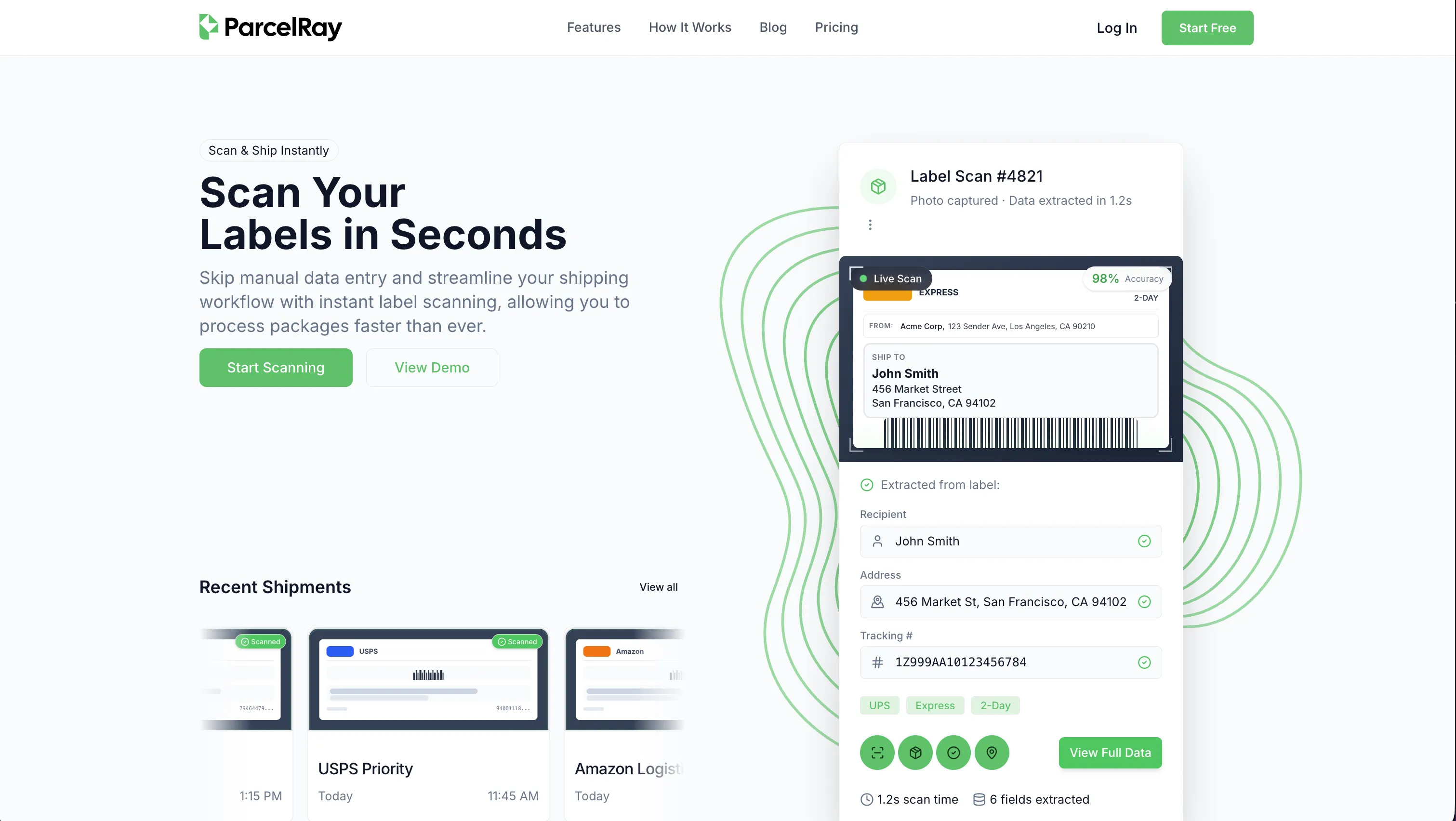
Multi-carrier support — ParcelRay processes labels from UPS, FedEx, USPS, Amazon Logistics, and other carriers out of the box. The system automatically detects the carrier format and extracts the right fields — tracking number, address, unit codes, customer IDs — without configuration.
Instant data extraction — average processing time is 1.2 seconds per label. The platform extracts six core fields per scan and standardizes address data automatically, cleaning up formatting inconsistencies before the data hits your system.
Integration ecosystem — extracted data syncs in real-time with Google Sheets, PostgreSQL, Shopify, Excel, and any system via REST API with webhook events. Sub-200ms latency on webhooks means your downstream systems update almost instantly. Zapier integration opens up connections to hundreds of additional tools.
Multi-client sorting — for warehouses handling multiple clients, ParcelRay intelligently routes parcels to the correct destination zones based on extracted data, turning a manual sorting process into an automated one.
Tech Stack
- Next.js (App Router) with TypeScript
- Tesseract OCR for fast label processing
- Anthropic Claude Vision for damaged label recovery
- REST API with webhook events
- Real-time database sync
- Vercel for hosting
The Result
ParcelRay shipped as a production-ready platform serving sellers and warehouses:
- 50 packages in 5 minutes — what used to take an hour of manual data entry now happens in a fraction of the time.
- 99.9% extraction accuracy thanks to the hybrid OCR approach, even on damaged or partial labels.
- Zero-config carrier detection means users scan any label without selecting the carrier first.
- Tiered pricing from free to $99/month makes the platform accessible from casual sellers (50 scans/month) to high-volume operations (15,000 scans/month).